From Raw Materials
to Conviction
Clade is where investment work becomes decision-ready. Documents, data, meetings, and history converge in an AI-native system built to surface insight, drive alpha, and reclaim time.
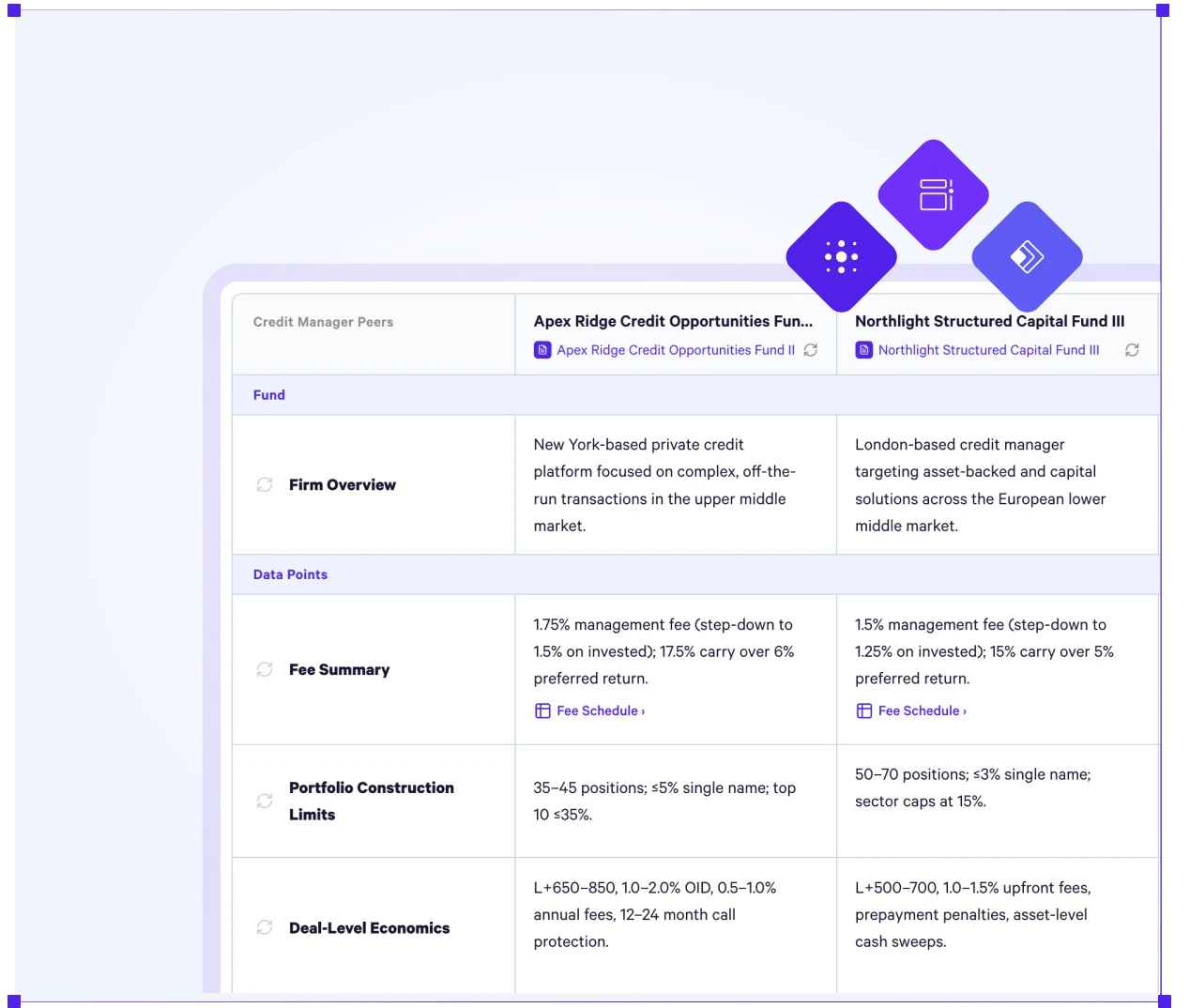
One system. Every source. Continuous intelligence.
Clade is used by investment teams to understand opportunities faster, evaluate them more rigorously, and stay grounded in context over time.
-
Transform fund and deal materials into structured data.
-
Prepare IC memos, diligence reports, and monitoring materials in minutes.
-
Monitor risk factors, open questions, and changes as information evolves.
-
Capture meetings, extract claims and follow-ups, and connect them to the investment record.
-
Analyze LPAs, side letters, MFN elections, and transaction documents with source-grounded precision.
-
Compare funds, deals, and strategies side-by-side from the full investment record.
-
Reason across documents, notes, meetings, and history using investment-specific context.
-
Transform fund and deal materials into structured data.
-
Prepare IC memos, diligence reports, and monitoring materials in minutes.
-
Monitor risk factors, open questions, and changes as information evolves.
-
Capture meetings, extract claims and follow-ups, and connect them to the investment record.
-
Analyze LPAs, side letters, MFN elections, and transaction documents with source-grounded precision.
-
Compare funds, deals, and strategies side-by-side from the full investment record.
-
Reason across documents, notes, meetings, and history using investment-specific context.
Every data input. Context compounds.
Clade ingests the full range of deal, fund, and portfolio materials—across documents, communications, and data.
Information is parsed, linked, and anchored to source documents and versions, so every insight remains traceable.
Nothing is forgotten. Everything accrues.
From unstructured inputs to structured insight
Clade applies investment-specific semantic analysis to identify what actually matters: strategies, exposures, terms, performance, risks, entities, and time.
This foundation is what gives the platform its strength—enabling consistent comparison, change detection, and output across funds and deals, vintages, and asset classes.
Core capabilities. Built for agentic investment workflows.
-
Research & Diligence
IDD and ODD workflows are automated with generative analysis. Key terms are extracted, managers are compared, inconsistencies are surfaced, and a complete diligence record is built—without stitching together spreadsheets, documents, and notes.
-
Automated Report Writing
With a click, disparate inputs become IC-ready materials teams can stand behind. Investment Committee memos, tear sheets, and ODD reports are generated from your data, your history, and your standards—preserving reasoning, not just conclusions.
-
Meeting Intelligence
Diligence meetings become usable immediately. Calls are captured and analyzed in asset-class context agentically, ensuring insights don't disappear into static notes. Claims, risks, and follow-ups are identified, labeled, and linked directly to the broader investment record.
-
Portfolio Monitoring
The platform continuously tracks what changes and what quietly drifts. As new letters, DDQs, updates, and filings arrive, material differences are flagged and elevated into questions—highlighting risk and strategy drift early.
-
Knowledge Retrieval
Ask real questions. Get grounded answers. Teams query across documents, notes, meetings, and history using natural language without hunting for answers or managing files. Every response remains anchored to source evidence.
-
Institutional Memory
Every document, meeting, and decision becomes part of a shared firm record. Analysts inherit context instead of rebuilding it, and knowledge compounds across deals, vintages, and team transitions—surfacing exactly when relevant.
Intelligence that compounds.
Each document reviewed, decision made, and outcome observed strengthens the system’s understanding—creating a durable investment memory that doesn’t disappear when people move on.